
Most journaling advice assumes you have an empty hour and a quiet house. You probably don't. You have the ten minutes between clearing the plates and the next thing, and a notebook somewhere in a drawer. That is enough. Ten minutes is long enough to build a habit that survives a bad week, a heavy month, and the ordinary Tuesday when you'd rather scroll. The trick isn't discipline. It's lowering the bar far enough that you can step over it while tired.
Why short entries beat long ones
A page and a half sounds lovely and takes twenty-five minutes. That entry competes with sleep, with the laundry, with the last twenty minutes of the evening you were actually looking forward to. It loses, and then you decide journaling isn't for you.
Ten minutes competes with nothing. It fits between two other things without rearranging your day, which means it happens on the days that matter — the ones where you're busy and slightly frayed and most in need of somewhere to put your thoughts.
There's a second reason. When you know you only have ten minutes, you stop circling and write the thing that's actually on your mind. The constraint does the editing for you. A short entry you wrote tonight is worth more than the perfect entry you planned for Sunday.
The shape of a ten-minute entry
You don't need to reinvent your approach every evening. Give the ten minutes a loose structure and your brain will settle into it faster, the way it settles into a familiar route home.
Minute one: date the page
Write the date, the day, and one word for the weather or your mood if you like. This is a warm-up, not a test. It also means that in six months you can find your way around the notebook without reading every page.
Minutes two to five: three short lines
Answer three questions, one line each. Don't expand unless something tugs.
- What happened today that I want to remember?
- What did I notice — in a conversation, in my own head, in the room?
- What do I want from tomorrow, in one small, doable piece?
Three lines is a low bar on a bad night and a starting point on a good one. Some evenings the third line turns into a paragraph. Let it.
Minutes six to nine: one prompt
Pick a single question from the list below and answer it in three or four sentences. One prompt, not five. If the prompt pulls you somewhere unexpected, follow it and leave the rest of the structure behind.
Minute ten: close the loop
Write one sentence about tomorrow — something to finish, someone to reply to, a thing to bring. Then close the notebook. Closing it matters; an open notebook on the table reads as unfinished business, and unfinished business is what makes people quit.
The five-minute setup that saves you every night
Most missed entries aren't caused by a lack of willingness. They're caused by a notebook that's in the wrong room and a pen that's run dry. Spend five minutes on this once and the routine gets much easier.
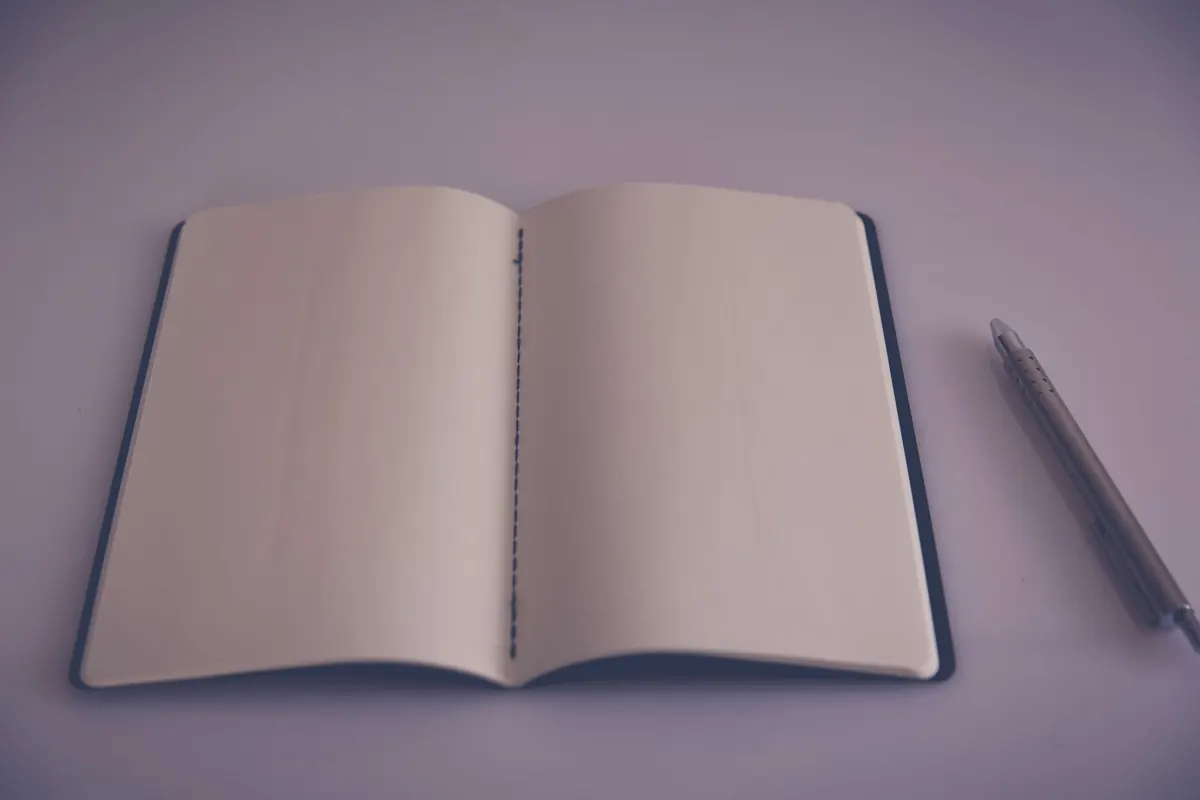
- A notebook that lies flat. A stitched or spiral-bound book that opens properly is easier to write in than a stiff casebound one you have to hold open.
- Two pens you like, in the same place. A favourite pen that skips is a small irritation that becomes a reason not to start. Keep a spare in the back of the book.
- One fixed spot. A chair, a corner of the kitchen table, a cushion by the window. Same place, most nights.
- Your prompts written on the inside cover. Ten lines in the front of the notebook means you never sit there wondering what to write about.
- A marker for where you stopped. A ribbon, a paper clip, a slim bookmark. No hunting for the last page.
- Your phone in another room, or face down and on silent. Ten minutes is short enough that this feels reasonable.
If you journal away from home — on a commute, in a café — keep a small notebook and a single pen in your bag and let the big notebook stay at home. Two books, two places, one habit.
Ten prompts for days when you have nothing to say
Nothing to say is normal. It usually means you're tired rather than empty. Pick one of these and write three sentences, badly if necessary.
- What did I do today that I'd happily do again tomorrow?
- What took more energy than it was worth?
- Who did I talk to today, and what stayed with me afterwards?
- What's the smallest thing that went right?
- What am I avoiding, and what would the first step look like?
- What have I been carrying around without saying it out loud?
- What did I notice today that I'd otherwise forget — the light, a sound, a smell, a line someone said?
- What decision did I make today, and how did I make it?
- What would make tomorrow easier for the version of me who wakes up at seven?
- What am I looking forward to, even slightly?
How to keep the habit without willpower
Attach the ten minutes to something you already do without thinking. After the coffee is made. After the last plate is dried. After the dog comes back in. The existing routine becomes the cue, and you stop relying on remembering.
Allow two-line days. Some nights you'll write the date and one sentence and shut the book. That counts, and it keeps the chain going. A habit made of minimum days is sturdier than one made of ideal days, because the minimum is what shows up in a hard week.
Don't rewrite, don't correct your handwriting, and don't read it back as an editor. The page isn't a performance. If you catch yourself writing for an imagined reader, write "for me only" at the top of the page and carry on.
Track it lightly — a small tick in the margin, nothing more elaborate. Once a month, sit down with a cup of tea and read three or four old entries. That reread is the reward, and it's what turns a routine into something you'd miss.
When you miss a week, don't start over
You will miss a week. There'll be travel, or flu, or a run of late nights. The mistake is treating the break as an ending and beginning again from zero with a fresh page, a fresh notebook, a fresh set of rules. Instead, keep going from where you stopped. Turn to the next page and write a re-entry entry: where you've been, what happened, and what you'd like the next ten days to look like. Two paragraphs. That's the whole reset.
The same applies if you skip a single evening. One missed night is nothing. Two in a row is worth noticing, and the fix is usually practical — the pen's gone missing, the notebook is under a pile of post, the ten minutes have drifted to a time when you're too tired. Move the slot earlier rather than trying harder.
Start tonight with one line
Don't plan a system. Put a notebook and a pen where you'll be sitting at the end of the day, write the date, and answer one question: what do I want to remember about today? One line is a completed entry. Tomorrow, aim for three. Within a fortnight the ten minutes will feel less like a task and more like the part of the evening where you finally hear yourself think.
Photo: Markus Spiske / Pexels